
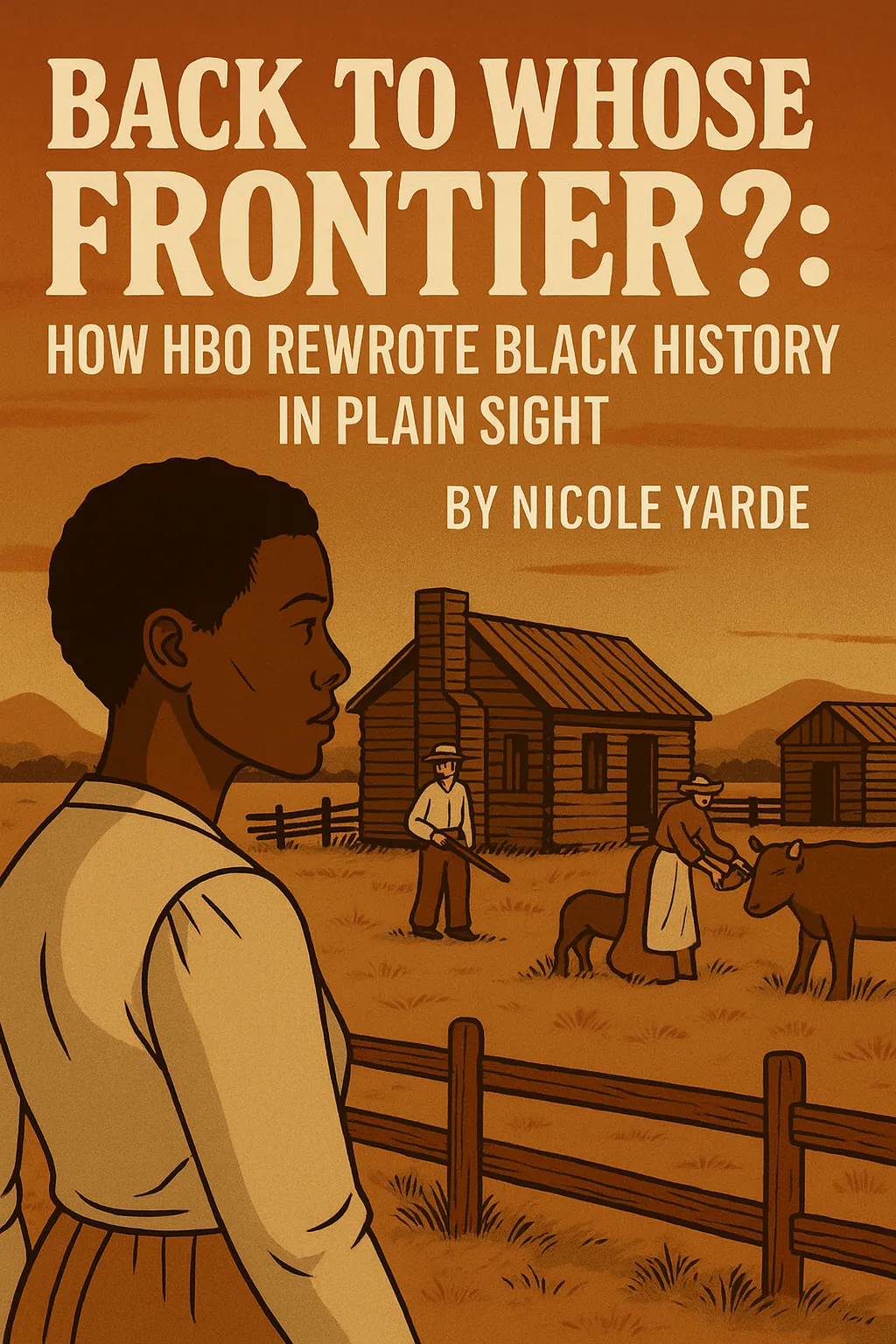
HBO’s new reality show, Back to the Frontier, wants to be a social experiment. It aims to teach us something about grit, survival, and the American spirit by dropping three families into a reenactment of 1880 frontier life, with no Wi-Fi, no running water, just raw land and period clothing.
But one thing becomes clear almost immediately: this is a frontier missing its ghosts.
In the series, three families are transported “back in time” to live as homesteaders in a simulated version of the American West. The Halls from Florida, a white-presenting family with three children; the Lopers from Alabama, a Black family with two sons and a grandmother; and the Hanna-Riggs, a gay white couple from Texas with twin boys. They’re each tasked with surviving the social, political, and environmental conditions of the 1880s.
The cast is diverse. The terrain is challenging. The premise is ambitious.
And yet, watching the first episode, I couldn’t shake the questions:
Whose version of the frontier are we telling? And who’s been left out of the story?
The Wrong “But”
The most revealing moment in the pilot unfolds at the Land Office, where the families arrive in full 1880s attire to register for their homesteads. A posted sign outlines the land application process and includes a pointed restriction: married women cannot buy land.
After reading it aloud, Mrs. Loper, the African American mother, turns to her sons and explains, with quiet conviction, that women in 1880 had very few rights. She reminds them that women’s suffrage came much later, offering a brief but meaningful lesson in historical injustice.
Jason Hanna, one of the gay fathers, offers his own reflection in a solo interview:
“Coming back to the 1880s, there were no two-dad families.”
These moments are framed as teachable. Enlightening, even. And they are.
Women’s rights. LGBTQ+ visibility. Acknowledged, uplifted.
So when the three men are invited into the Land Office, Mrs. Loper excluded, they’re greeted by homestead history expert Dr. Jacob K. Friefeld, who begins with reverence:
“The Homestead Act of 1862 was one of the most important social policies in American history. It gave Americans access to their own little piece of the American Dream. Today, there are nearly 93 million ( yes, million) descendants of homesteaders.”
He continues: Abraham Lincoln signed the act. Americans were given land.
Then he says it —
“But…”
I lean forward.
Here it comes, I think. The moment of honesty. The part where we acknowledge that in the real 1880s, the Black man standing in front of him wouldn’t have been allowed in that room. That by law, by violence, by design, Black families were systematically excluded from the promise of land and legacy.
But instead, Dr. Friefeld says:
“It wasn’t free, because homesteaders had to earn their homes by working hard and farming the land.”
That was his “but.”
Really?
So let’s tally it up, HBO.
You gave us a teachable moment about women’s rights.
A nod to gay rights.
And when it came to Black Americans?
Not a word.
Two out of three, I guess, is good enough for a show looking to seem inclusive without telling the whole truth.
And then you doubled down by implying that all it took to be a homesteader was hard work. As if violence, policy, and racism weren’t the true barriers. As if Black families were denied not because of their skin, but because they didn’t farm hard enough.
No one mentioned that the Homestead Act was weaponized against Black people. No one mentioned that in 1880, the American frontier was a place from which we were actively barred. Not a word about Jim Crow, sharecropping, racial terror, or land theft.
And in that deliberate silence, Back to the Frontier made a familiar American choice:
To whitewash the past for the sake of comfort.
To smooth out the truth for palatability.
To teach history, but only the parts that won’t upset the wrong people.
Erasure by Omission
In that moment, when the white land agent says “93 million Americans” benefited from the Homestead Act, we get a glimpse into the core problem of Back to the Frontier. It wants to teach, but only enough to feel educational without making anyone uncomfortable.
Gay rights? Check. Women’s suffrage? Check.
But Black pain? Black exclusion? Black trauma?
Silence.
And that silence isn’t neutral. It’s violent. It’s a form of cultural gaslighting, the kind that makes it easier to pretend the past was hard but fair, challenging but equal. It feeds into the lie that everyone had the same chances and that hard work was the only barrier.
But hard work didn’t stop Black homesteaders. Laws did. Violence did. Policy did.
If you can’t say that, then don’t say anything at all.
The History They Didn’t Tell
Let’s be clear: the Homestead Act of 1862 did open up millions of acres for settlement. But access to that land was not equal. While technically race-neutral on paper, in practice, Black families were systematically denied the resources, protections, and safety required to stake and keep a claim. White settlers often terrorized or ousted Black homesteaders. Government agents ignored their applications. The land itself was sometimes granted, only to be taken through intimidation or fraud.
By 1880, Reconstruction was unraveling. The Supreme Court had already begun dismantling the protections of the Reconstruction Amendments. Black Codes were being replaced by more formalized Jim Crow laws. Racial violence was not an occasional event; it was policy, practice, and precedent.
For many Black families, “back to the frontier” wasn’t an option; it was a fantasy. Or worse, a lie.
Yet Back to the Frontier found time in its pilot episode to gently nod toward the historical oppression of women and queer people, while somehow skipping over the brutal erasure of Black freedom and land access in the exact same era.
Where You Film Matters: History Without the Soil
It’s also worth noting that the show isn’t filmed in America at all. It was shot in the open plains of rural western Canada, about an hour outside of Calgary. It’s beautiful, with sweeping grasslands and mountain views. But it’s also convenient.
Because if you’re going to recreate the illusion of a shared American past, one where three very different families “start from scratch” on equal footing, Canada is the perfect place to pretend none of it happened. It’s literally and symbolically a safe distance from the soil where American racial injustice was written in blood.
You can’t recreate the past if you avoid its geography.
You can’t honor the truth if you dodge the land that holds it.
This physical displacement mirrors the narrative displacement at the heart of the show. It’s not just the land that’s been whitened. It’s the entire framing of who suffered, who was silenced, and who gets to be nostalgic for the past.
The Weight of Generational Exclusion
The effects of that erasure didn’t stay buried in the past.
Early in the show, host Melissa K. Norris proudly shares that she is a fifth-generation homesteader, living on 55 acres of land. It’s a beautiful legacy, one she inherited through land access that, historically, so many others were denied. This isn’t a critique of her success. Melissa comes across as kind, hardworking, and sincere. But her story is also a living illustration of what it means to benefit from a system built to uplift some and exclude others.
Her family was handed a ladder generations ago. They climbed it, built on it, passed it down. Their starting line came with acreage. Stability. Possibility.
What a blessing.
Now contrast that with Mrs. Loper, the Black mother on the show, who breaks down in tears over dinner, spooning canned ham and baked beans onto her plate. Through tears, she shares that she grew up in poverty and that she’s spent her adult life working tirelessly to ensure her children never have to know that same struggle.
And yet here she is, “back in 1880,” reliving that same struggle under the guise of a reenactment.
Watching her, I couldn’t help but feel that what unfolded wasn’t just about missing modern comforts. For me, it represented something much heavier: doors being closed, generation after generation.
Even though Mrs. Loper is successful in her own right, she doesn’t have the luxury of tracing landownership back five generations.
As she fought back tears, the moment struck me. It wasn’t about the beans or the canned pork. It was about what the scene stirred in me: the quiet ache of generational injustice. The grief of watching others inherit land, wealth, and stability, while knowing that so many of our families were locked out, burned out, pushed aside.
It hit me like a truth I already knew but still hated to feel:
The American Dream was never built with us in mind.
On one side, a family standing five generations tall on 55 acres.
On the other side, a family representing millions who never got the chance, because their lineage was deliberately severed five generations ago.
And the most insidious part?
We’re still being cut out.
Just more subtly now.
With redlines instead of ropes.
With zoning laws instead of shackles.
With policy language that smiles while it says “no.”
We don’t need a time machine to see the impact of that exclusion. We have the data.
In early 2025, Q1 data show Non-Hispanic White households own homes at a rate of 74.2%, compared to 44.7% for Black households. That disparity hasn’t narrowed in a century; in fact, it’s remained stubbornly wide. Since 1900, the Black–White homeownership gap has hovered around 25–30 points, peaking at nearly 30 points in 2020.
It’s as if the Homestead Act planted a tree in 1862 and said, “Eat.” But only some families got the fruit. Others were kept out of the orchard, generation after generation.
That fruit? It became houses, wealth, and tradition. It became stability, inheritance, the ability to say, “We’ve always had this.” The denial of it became hunger, renting, struggle, shame, and the emotional break we watched in real time as one mother scooped beans out of a large mason jar and said, “I never wanted my children to know this.”
That’s the legacy this show tiptoes around.
That’s the truth hiding beneath the staged cabins and prairie dresses.
And that’s what makes the entire premise dishonest: it asks us to pretend everyone is starting from the same place.
But we’re not.
We never were.
The Grandmother Who Said Nothing
One of the show’s most poignant elements is the Loper family’s grandmother. A 72-year-old Black woman from Alabama, soft-spoken, poised, watchful.
It is announced early in the show that she won’t stay the entire season.
We aren’t told why she is going to leave. Maybe it was health. Maybe it was discomfort. But if she looked around and realized, This wasn’t made for us, I wouldn’t blame her.
Because to see your history softened, distorted, or skipped over, while being asked to perform labor inside of it, is exhausting.
She shouldn’t have had to stay.
Not to be silent. Not to be background. Not to be erased again for someone else’s lesson.
And we shouldn’t have to stay quiet while it happens.
Hope for What Comes Next
To be fair, this is only the first episode. Maybe future episodes will course-correct. Maybe the Black family will have a chance to speak truthfully about what this experience represents. Maybe the show will confront the systems that made the “American Dream” impossible for so many.
But they didn’t start well. And in storytelling, the beginning matters.
You don’t need to turn every show into 12 Years a Slave. But you do need to tell the truth. You gave ten seconds each to women’s rights and gay rights.
Black Americans deserve their ten seconds, too.
Because Black history isn’t optional, it isn’t extra.
It is American history.
We were there. We tried to build.
We planted. We prayed. We persevered.
Then we were burned out. Run off. Lynched. Erased.
But we are not ghosts.
We are the blood in that soil.
We are the deeds unclaimed.
We are the memory your narrative keeps skipping.
So if you’re going Back to the Frontier, HBO —
Take us with you.
Or stop calling it history.
https://medium.com/@yardenicole/back-to-whose-frontier-how-hbo-rewrote-black-history-in-plain-sight-07ba164137f8
Written by : Nyarde