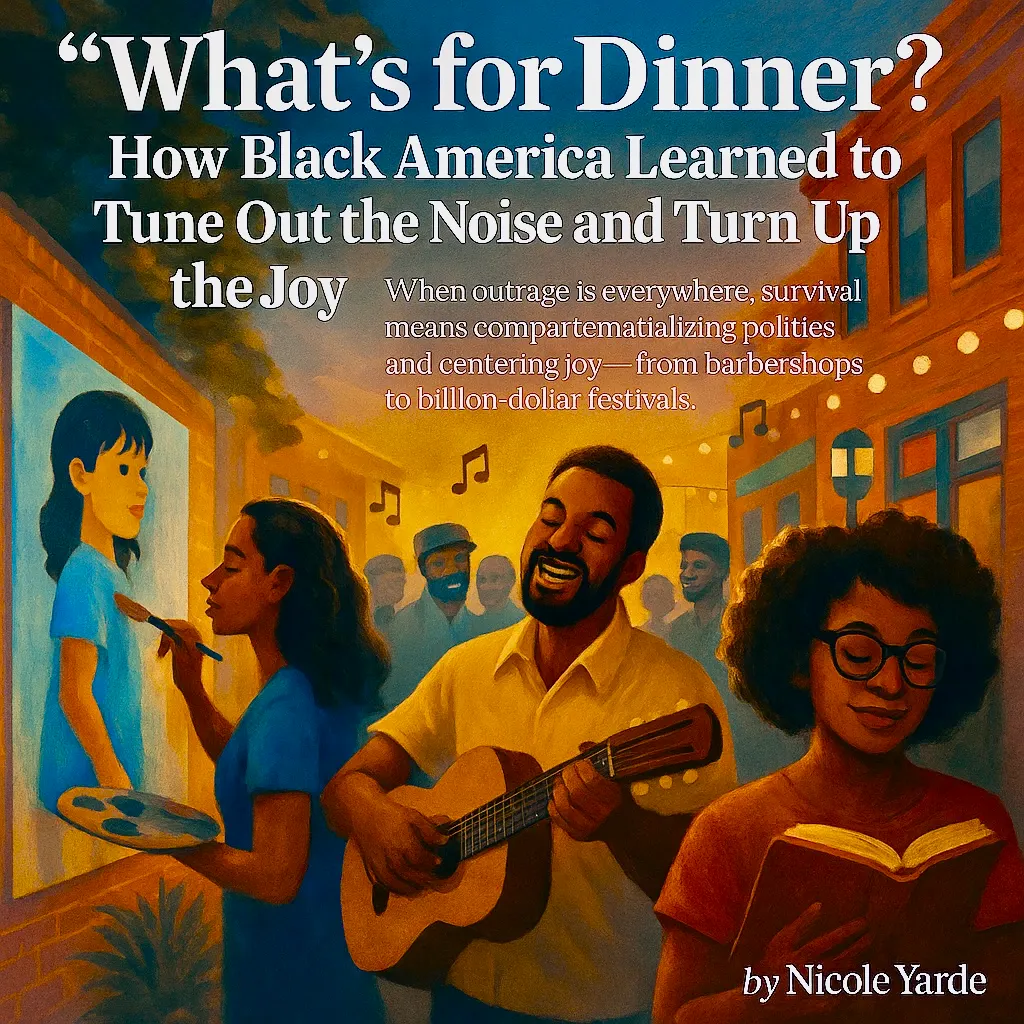
When outrage is everywhere, survival means compartmentalizing politics and centering joy from barbershops to billion-dollar festivals.
As this summer winds down, I keep thinking about how Black folks showed up for joy this year. We were outside, and I mean really outside. Brooklyn, Harlem, D.C., every block party became a safe space, every street corner a sanctuary. Walk through any of these neighborhoods on a Saturday and you’d see it: hydrants cracked open by noon, music spilling from speakers (that definitely “aren’t that loud”), kids running barefoot through the spray. From Bed-Stuy to 125th Street to U Street, we turned asphalt into dance floors. The barbershop stayed packed with men who didn’t really need haircuts; they needed the conversation that comes free with the fade. Meanwhile, a muralist spent the season painting a little Black girl on a brownstone wall, her blue dress getting brighter with each weekend, as permanent as the building itself.
This is Black joy. Everyday. Unapologetic. And far more complicated than America ever wants to admit.
Now glance at the headlines: another book ban, another congressional hearing, another politician rehearsing outrage for the cameras. The firestorm is real, but here’s what’s striking. It isn’t scorching us the way some imagined it would. Plenty of Black folks have stepped back from the political noise, not out of apathy but out of memory. We’ve seen this America before. Our parents and grandparents lived through earlier versions of the same performance. We know how the flames work.
So instead of letting outrage devour every part of our lives, we’ve learned to compartmentalize it. We carry awareness, but we don’t let it eat us whole. The proof is in the comment sections: while the world debates its collapse, the top replies in Black spaces are things like, “What’s for dinner?” or “I’m running to BJ’s, you need anything?” Call it what you want, but indifference doesn’t look like this. This is something else, call it balance, or just knowing where to spend yourself. One foot in, one foot out of the mainstream chaos. We stay tuned in, maybe even throw a line or two into a work conversation, then turn our energy back to the places that actually feed us.
The same energy that used to go into organizing marches now goes into organizing festivals. The feet that would’ve been on Pennsylvania Avenue are at the block party. Especially after November, when we watched our warnings ignored and our votes suppressed — again — we’ve decided that joy is a better investment than another march that ends up as a hashtag.
A Long Memory for Firestorms
If you’re Black in America, you don’t need to be convinced that the flames are real. You inherit the fire drill. Our grandparents told us about sundown towns and redlining. Our parents talked about the crack epidemic, about stop-and-frisk, about schools starved of resources. We’ve lived through enough “new” crises to know they’re recycled.
There’s an old saying: when America catches a cold, Black people get the flu. You see it in education, where Black college graduates leave school owing $25,000 more than their white peers. Among Black women, 43.3% carry student debt, nearly double white women, triple that of white men. Four years out, almost half of Black borrowers owe more than they started with.
Add in blocked universal healthcare, knowing inequality has a body count. Add resistance to loan forgiveness, knowing Black women carry the highest burdens despite being the most educated demographic. The system doesn’t fail us by accident. It works exactly as designed.
And yet, alongside all of that, there has always been music, food, laughter, and art. We’ve always known how to make a dollar out of fifteen cents. Take oxtail, what enslaved people were given as scraps, the parts nobody wanted. Now it’s $20 a pound at the butcher, a delicacy on high-end menus. Chitlins, pig feet, collard greens, we took what was meant to be nothing and made it cuisine. Enslaved people braided escape routes into cornrows. Harlem Renaissance writers threw rent parties that funded entire revolutions in art. In the same years that civil rights leaders were being beaten in the streets, Motown Records topped the charts.
What history shows, again and again, is that attempts to smother us end up fueling the culture that keeps us alive.
The Festival Circuit: Joy at Scale
If you want proof of how joy can grow into something organized and undeniable, look at the festival circuit. It has never been Blacker or more vibrant.
The Caribbean knows this dance well. Take Barbados’s Crop Over, which started as enslaved people being allowed to celebrate when the sugar cane harvest ended. The plantation owners thought they were giving permission for a day off. What they gave, unintentionally, was the blueprint for resistance through celebration. Today, Crop Over brings millions in tourism dollars to Barbados, with Rihanna herself headlining the revelry. Trinidad’s Carnival grew from enslaved Africans mocking their enslavers’ masquerade balls, turning the master’s costume party into the Caribbean’s most powerful cultural export. From Jamaica’s Reggae Sumfest to every island’s festival, what began as stolen moments of joy in the shadow of brutality became the economic engines of entire nations.
Stateside, Rhiannon Giddens’ new Biscuits and Banjos festival is a deliberate reclaiming of folk, country, and blues through a Black Southern lens. What was once stripped of its origins and labeled simply “American music” is being returned to the communities that created it, center stage.
Raleigh’s African American Cultural Festival has been running for fifteen years, filling streets with food, art, and history that feeds both body and spirit. Denver’s Colorado Black Arts Festival, approaching its fortieth anniversary, has become one of the largest and longest-standing Black arts gatherings in the country. These events aren’t just cultural showcases. They’re economic engines. The National Endowment for the Arts estimates that Black cultural festivals generate millions annually in local revenue. Last year alone, the top 25 Black cultural festivals drew an estimated 3.2 million attendees and generated over $280 million in economic impact, numbers that mainstream media rarely mentions when discussing Black communities and economics.
The 2025 music festival season is saturated with unapologetically Black programming: Afrofuturist lineups, jazz collectives, trap symphonies, and crossover acts that refuse to fit inside one genre. These festivals aren’t hiding places. They’re declarations. We take the chaos they hand us and make it music, put our names in lights, pack the venues.
Compartmentalized Outrage, Centered Joy
This doesn’t mean life is easy, or that flames aren’t still burning. Police brutality, voter suppression, and economic inequities remain part of our daily reality. No one is fooled into thinking otherwise.
But we aren’t shocked. We’ve seen this country play out these same scripts before, and we’ve decided to protect ourselves differently this time. We just stopped showing up to perform our pain for audiences that never intended to help anyway.
White wellness influencers discovered “boundaries” and “self-care” and turned them into billion-dollar industries. We’ve been doing this work for centuries; we just called it “minding our business” and “keeping our peace.” Now they’re selling our survival strategies to each other for $200 masterclasses. The audacity is almost impressive.
That’s why so many of us keep one foot in and one foot out of the political circus. We track what’s happening, poke our heads up when needed, maybe drop a line or two in the office conversation, then pivot back to what actually matters: our families laughing at dinner, the barbershop debates, Sunday service, the bookstore’s quiet corners, the festival stage where we’re the headlines. We haven’t checked out (completely).
Choosing joy doesn’t mean we’ve stopped paying attention. We’ve gotten better at knowing which battles are worth the energy and which ones are designed to exhaust us. It’s refusing to bankrupt ourselves on outrage while knowing the system was built to drain us.
The Real Story
Black joy has always been heavy with meaning. Power never gave it permission to exist, which is exactly why it matters; every laugh, every song, every celebration is proof of what couldn’t be killed.
We learned from our ancestors how to find sweetness in the bitter. How to take scraps and make feasts. How to turn the very instruments of our oppression into the tools of our liberation. The banjo, brought from Africa, became bluegrass. The work songs became the blues. The church where we were told to be docile became the headquarters of the civil rights movement.
So next time someone asks why we’re not marching in the streets, tell them we’re busy drinking water and minding our business. Building generational wealth one festival at a time. Teaching our kids to braid both hair and resistance. Making oxtail so good, gentrifiers will pay $30 a plate for it.
We’re not avoiding the revolution. We’re funding it with joy. And yes, we’re charging admission.
When America asks why we’re not perpetually outraged, why we’re not marching every second the headlines demand it, the answer is simple: We didn’t stop caring. We just started choosing when to care. We know how this country works. We’ll show up when it matters, on our time, not on America’s schedule.
America may still be on fire. But in Brooklyn on a Saturday, in Raleigh in September, in Denver in July, at Barbados’s Crop Over, you’ll find us dancing, eating, painting, singing. Not because the storm isn’t real, but because we already know it is. And until the world serves something better, our answer will stay the same.
What’s for dinner? Joy.
Tell us: What’s keeping you grounded while the world spins?
Where do you find your light?
Written by : Nyarde