
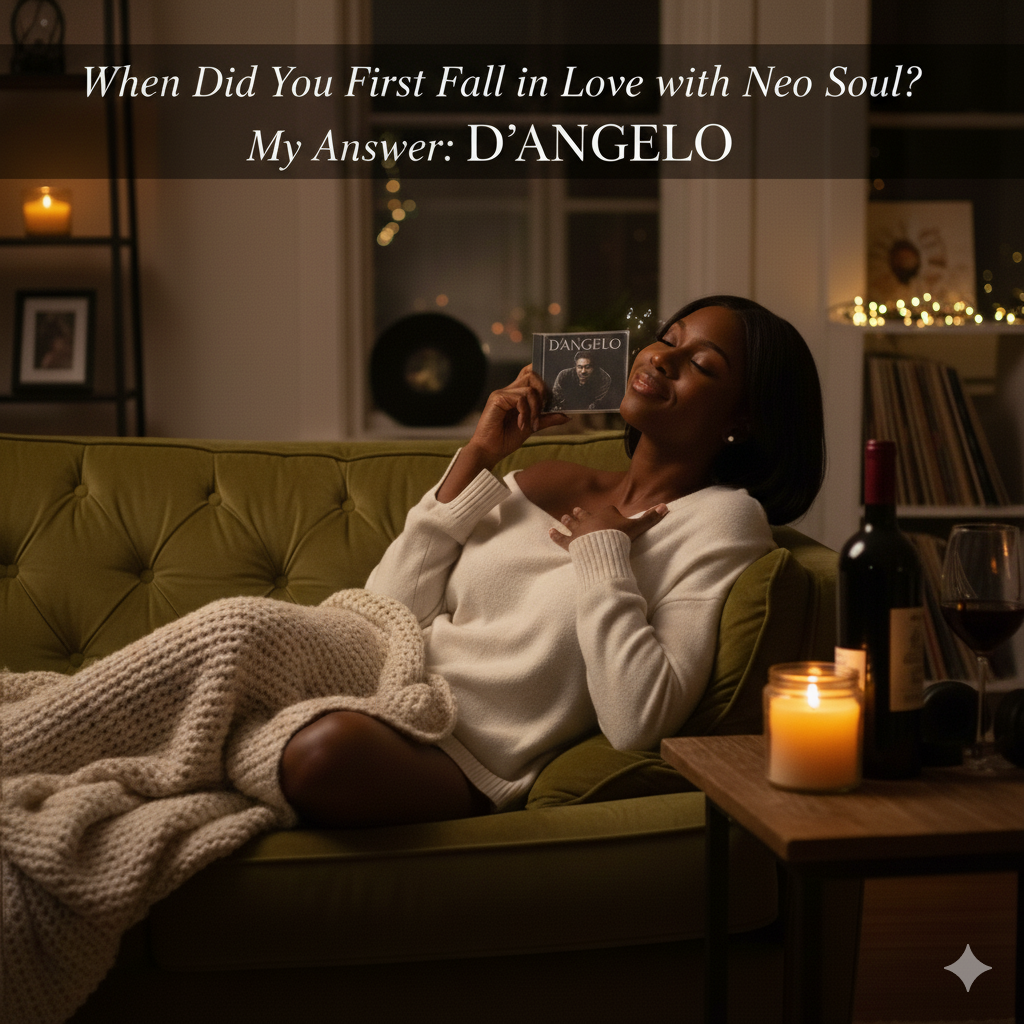
When Did You First Fall in Love with Neo Soul? My Answer: D’Angelo
A tribute to Michael Eugene Archer (1974-2025)
There’s a line in Love & Basketball that asks, “When did you first fall in love with hip-hop?” Today, I can’t move from my couch. I can’t stop feeling sad. Because I know exactly when I fell in love with Neo Soul.
Brown Sugar. D’Angelo’s first album. A gift from my first boyfriend that became the soundtrack to understanding what it meant to be unapologetically, luxuriously, sensually, and irrevocably Black.
What We’ve Lost
We’ve lost a legend. More than that, we’ve lost a symbol of an era when Black music didn’t have to announce its pride because it was born of it. D’Angelo, Jill Scott, Angie Stone, Erykah Badu, Musiq Soulchild: these artists were living Blackness. They gave us soundtracks that healed, protested, loved, and luxuriated in their own existence.
There was something radical about that.
D’Angelo made it cool to be dark-skinned, sensual, vulnerable. A Black man who could seduce you with just a hum. His music was validation, proof that soul could still shake the world.
And that’s what I miss today.
And by the way, I’m not knocking current artists. I love what SZA, H.E.R., Ari Lennox, and Kendrick are doing. They’re carrying the torch in their own way. But I wonder: if Brown Sugar dropped today, would it even make it to mainstream radio? Would it get the same rotation as Sexy Red? Probably not. The music’s brilliant as ever. Radio just forgot what depth sounds like.
The Revolution We’ve Lost
Once upon a time, revolutionary music was mainstream. Sam Cooke’s “A Change Is Gonna Come” played on regular radio. Nina Simone demanded we “Mississippi Goddam” in our living rooms. Marvin Gaye asked “What’s Going On” on the same charts as pop records. Michael Jackson and Stevie Wonder used their megaphones to move the world toward consciousness.
And then came the Neo-Soul movement: that beautiful burst of unapologetic Blackness that hit the airwaves like a revolution in slow motion. Silk and protest. Sweetness and defiance. The politics didn’t need to scream; it just existed, proudly, sensually, freely.
When D’Angelo sang, the world stopped pretending that soul was extinct. Sexy, yes, but also spiritual. Music you made love to, rolled up to, cried to, believed in. He didn’t need to yell, “I’m Black and I’m proud.” It was in the bassline.
In the breath.
In the being.
The Erotics of Revolution
There was something about Neo Soul, something about D’Angelo specifically, that was unapologetically Black without having to declare it. It didn’t need James Brown’s declaration of “I’m Black and I’m Proud” (though respect to the Godfather). Instead, it ran through your veins like blood itself—the capillaries to your heart.
D’Angelo made music that was revolutionary in its refusal to separate the political from the personal, the sensual from the spiritual. His was a Blackness that was simultaneously:
Soothing—like shea butter on weathered skin
Sexy—clothes sliding off without urgency
Sacred—church chords bent into Saturday night sermons
When D’Angelo cursed, it was silk. Profanity became poetry, desire became prayer. This man created a sonic space where making love was itself an act of resistance, where pleasure was political, where two Black bodies finding each other in the dark was revolution enough.
The Hypnosis of Truth
D’Angelo’s music was a drug. It didn’t matter if you’d known someone for ten minutes or ten years; he made you bond with that person like you’d been waiting your whole life for this moment. His voice took over your body like something chemical, heightening every nerve, releasing inhibitions you didn’t know you had.
This was possession.
His sound gave you permission to be primal. Permission you never knew you needed until it washed over you, and suddenly, you were grateful, so grateful, to finally let go. Under his spell, you became who you really were in the dark: hungry, unashamed, fully alive in your skin.
Voodoo wasn’t just an album title. The whole thing was a spell. A conjuring. He took the funk of our ancestors, the church of our grandmothers, the hip-hop of our streets, and the jazz of our rebellion, and created something that made you want to do unspeakable things with the person next to you while simultaneously understanding yourself more deeply.
This was music that made you want to roll something up, pour something strong, and get lost in another person, not to escape yourself but to find yourself through the geography of another’s skin. Every note was permission to be fully human, fully Black, fully present in your desire and your power.
The Weight of This Loss
Losing D’Angelo feels like losing a piece of history, a fragment of our collective soul, a guardian of our sensuality, our complexity, our right to be whole. He represented a time when Black artistry didn’t have to choose between the conscious and the carnal, between the streets and the sheets, between revolution and romance.
In his music, protest lived in the curve of a bassline. Resistance resided in the refusal to rush a rhythm. Liberation lurked in the space between notes, in the breath before the bridge, in the moan that could mean pleasure or pain or both, because aren’t they always intertwined in the Black experience?
The Inheritance
Today, I’m not leaving my house. I’m playing Brown Sugar, then Voodoo, then Black Messiah. The holy trinity of modern soul. I’m lighting candles like this is a séance, because maybe if I play “Untitled (How Does It Feel)” enough times, I can conjure not just the man but the moment he represented. That moment when mainstream Black music could be experimental and successful, conscious and sensual, deeply weird and undeniably groovy.
We need our D’Angelos. We need artists who understand that the bedroom and the revolution are not separate spaces, that making love and making change are parallel acts of creation. We need voices that can make you question your relationship with God and your lover in the same breath.
So, when did I first fall in love with Neo Soul?
When D’Angelo’s voice first crawled through my speakers like smoke through a cracked window. When I understood that music could be meditation and masturbation, church and juke joint, history lesson and prophecy. When I realized that being Black could sound like basslines that don’t apologize for taking their time, like harmonies that hold history in their layers, like a man brave enough to stand naked (literally and figuratively) before the world and make vulnerability look strong.
D’Angelo gave us maps to parts of ourselves we didn’t know existed. Permission slips for our pleasure. Hymnals for our humanity.
And now he’s gone. And I’m sitting here, surrounded by his vinyl, his voice filling every corner of my apartment, trying to hold onto something that was already ethereal. The music remains, but the possibility he represented? That moment when the underground and the mainstream kissed and created something beautiful? It feels more distant than ever.
Rest in power, D’Angelo. You were our prince of passion, our prophet of pleasure, our reminder that revolution could be whispered in the dark and still shake the foundations of the world.
Your first album taught me how to fall in love. Not just with Neo Soul, but with the infinite possibilities of Blackness itself.
That’s a love that death can’t touch.
When did I first fall in love with Neo Soul? When a man named D’Angelo reminded me that being Black could sound like freedom itself.
Michael Eugene Archer (D’Angelo)
February 11, 1974 – October 14, 2025
The revolution will be harmonized.
Written by : Nyarde


To put this into words as quickly as you did and to capture all the social and cultural complexities of times past and present, is profound. Sometimes we need help to put words to what feels ineffable for us in the moment. Thank you for doing that for us.